
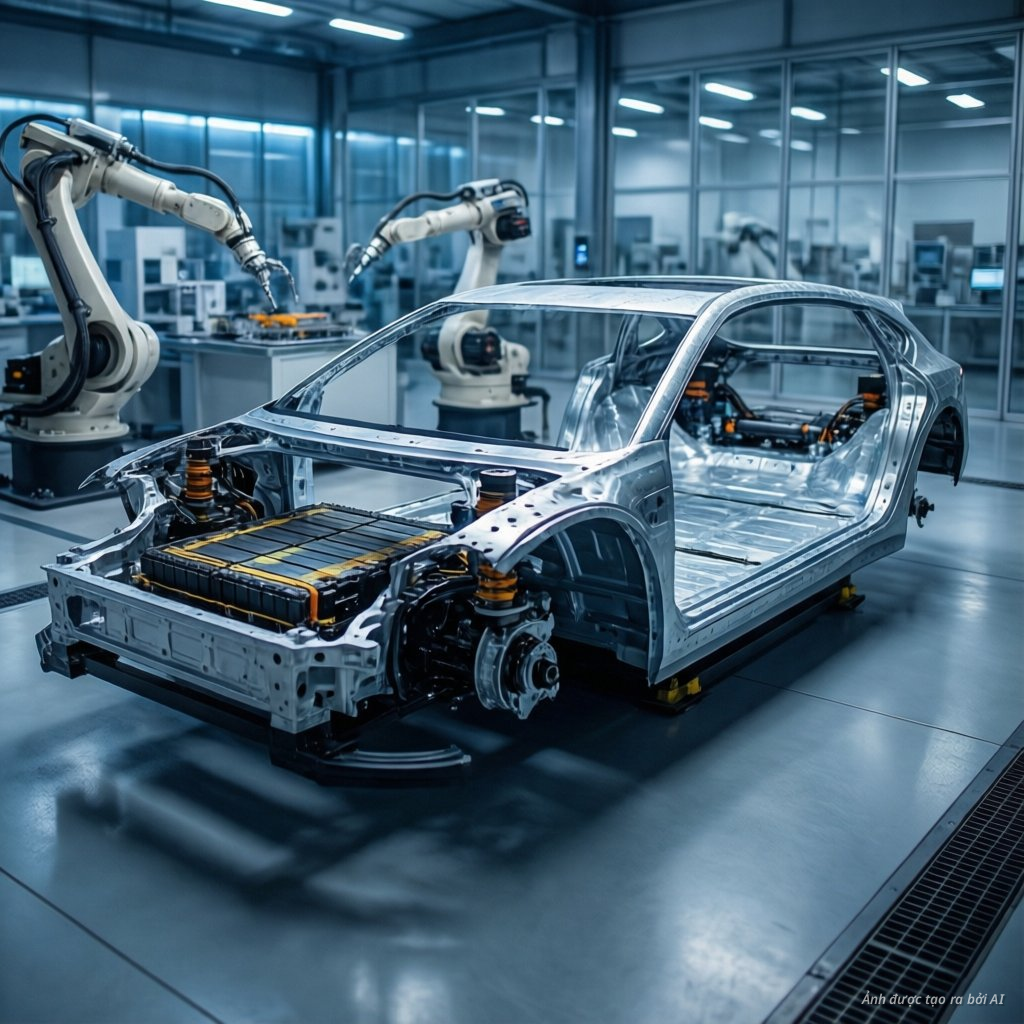
The automotive industry faces a critical engineering challenge today. Electric vehicles (EVs) offer zero-tailpipe emissions, yet their heavy battery packs create a significant weight penalty. To maximize driving range and minimize environmental impact, engineers must rethink vehicle architecture from the ground up. This requires a dual focus on lightweighting and design for disassembly (DfD).
Lightweighting involves replacing traditional steel with advanced, low-density materials to offset the mass of high-voltage batteries. Meanwhile, DfD ensures that components can be separated, repaired, or recycled at the end of their life cycle. By integrating these strategies, manufacturers can significantly reduce the embodied carbon of modern electric vehicles [1].

The role of lightweight materials in EV performance
Reducing vehicle mass by 10% can improve driving range by approximately 6–8%. This efficiency gain is vital for the mass adoption of electric mobility. Engineers are increasingly turning to aluminum alloys for subframes and battery enclosures. Aluminum provides a high strength-to-weight ratio and is infinitely recyclable [1].
Beyond aluminum, advanced high-strength steels (AHSS) allow for thinner structural components without compromising safety. These materials enable a lighter body-in-white (BIW) structure. Furthermore, bio-based composites are gaining traction in interior design. Using natural fibers like flax or hemp reduces weight by up to 30% in non-structural parts [3].
Designing for disassembly and circularity
Traditional automotive assembly often relies on permanent adhesives that make recycling nearly impossible. To achieve true sustainability, designers must shift toward reversible mechanical fasteners. This circular approach [2] allows for the rapid removal of components. By avoiding co-molded multi-materials, manufacturers can keep material streams pure for future recovery.
Modular architecture is the backbone of this strategy. When vehicles are built as self-contained modules, repairability becomes a standard feature rather than an afterthought. This optimizing the electric vehicle lifecycle from design to end-of-life approach ensures that individual parts can be upgraded or remanufactured. Consequently, the total environmental footprint of the vehicle is drastically reduced [3].
Innovation in battery pack architecture
The battery pack remains the heaviest and most complex component of an EV. Modern design trends now prioritize serviceability at the module and cell levels. By making these components easily accessible, manufacturers facilitate second-life applications, such as stationary grid storage. This transition is supported by new regulatory frameworks like the EU Battery Regulation [3].
Digital tagging and color-coding are also becoming essential tools. These features allow automated systems to identify materials quickly during the recycling process. Such innovations are central to projects like the BMW i Vision Circular [4], which aims for 100% recycled material utilization. These concepts prove that sustainability and high performance can coexist in modern automotive engineering.
The path toward climate-neutral production
Abating material emissions is the next frontier for the automotive sector. Global OEMs are setting ambitious targets to eliminate emissions throughout their entire supply chains. This requires a holistic view of the circular economy for ev batteries and vehicle frames [5]. By selecting materials with lower embodied carbon, engineers can make a profound impact.
Collaboration between material scientists and industrial designers is more important than ever. Designers must prioritize mono-material construction to simplify post-consumer recycling. Meanwhile, engineers must ensure these materials meet stringent crash-test standards. This synergy is the key to creating the next generation of sustainable transportation [5].
Conclusion
Sustainable EV design is not just about electrification; it is about material efficiency and circularity. By leveraging lightweight materials and embracing design for disassembly, the industry can overcome the weight paradox. These strategies reduce energy consumption during production and extend the life of valuable resources. As we move toward a carbon-neutral future, these engineering principles will define the leaders of the automotive world.
More Information
- Lightweighting [1]: The practice of using low-density materials like aluminum and composites to reduce vehicle mass, thereby improving energy efficiency and increasing the driving range of electric vehicles.
- Design for disassembly [2]: An engineering methodology that structures vehicle components to be easily separated, repaired, or recycled, avoiding permanent adhesives and complex multi-material bonds.
- Circular economy [3]: An economic system aimed at eliminating waste and the continual use of resources through recycling, remanufacturing, and modular design strategies in manufacturing.
- Bio-composites [4]: Sustainable materials made from natural fibers, such as flax or hemp, combined with bio-resins, used to replace heavier plastics in automotive interior components.
- Embodied carbon [5]: The total greenhouse gas emissions generated from the extraction, manufacturing, and transportation of materials used to build a vehicle before it even hits the road.