
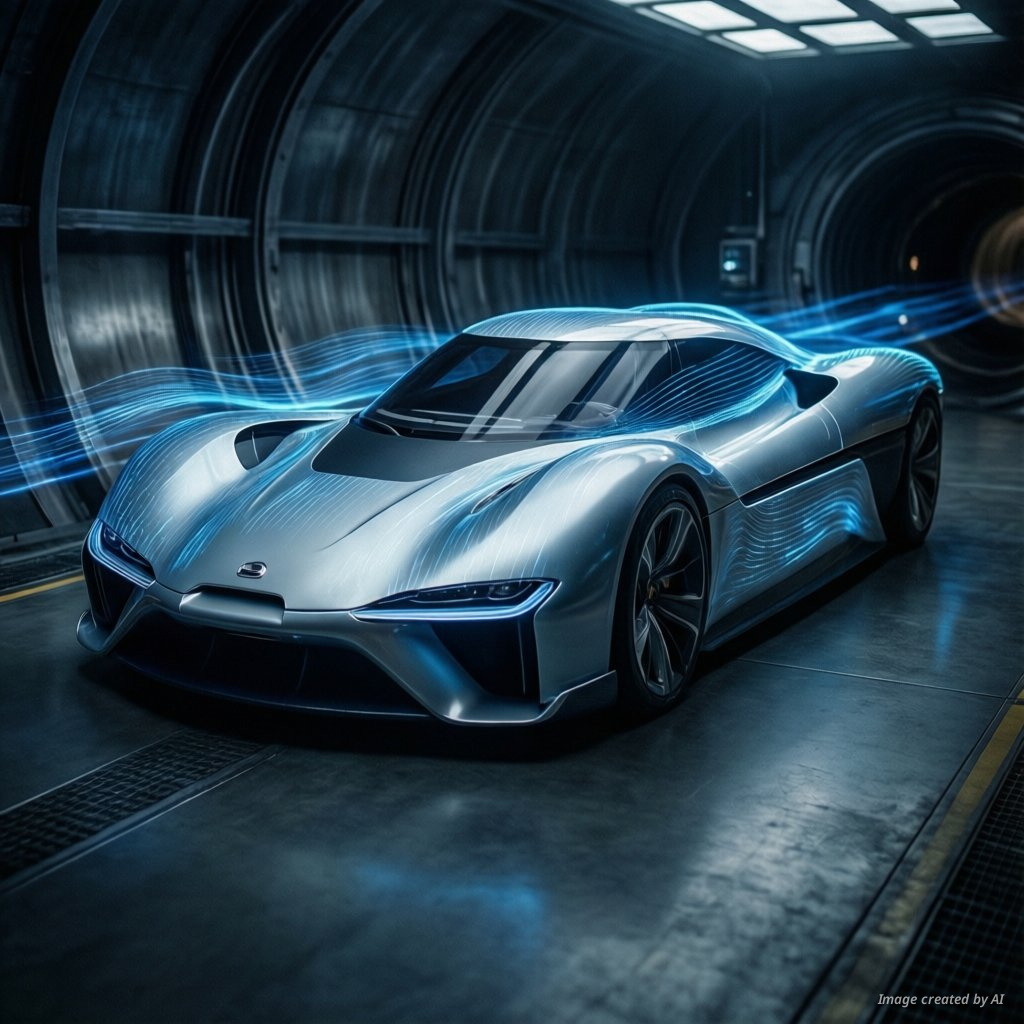
In the rapidly evolving world of electric vehicles (EVs), engineers face a constant challenge. They must balance battery capacity, vehicle weight, and driving range. While battery technology continues to improve, there is a more subtle, yet powerful, tool at their disposal. Aerodynamics has emerged as the ultimate secret weapon for modern automakers [1].
Unlike traditional internal combustion engine vehicles, which lose much of their energy through thermal inefficiency, EVs are highly efficient at converting electricity into motion. Because of this, air resistance becomes the primary enemy of range at highway speeds. By mastering the way air flows over a vehicle, manufacturers can unlock significant performance gains without adding heavy, expensive battery packs [2].
The physics of drag
To understand why aerodynamics matters, we must look at the drag equation. Drag force is determined by air density, vehicle velocity, the frontal area, and the coefficient of drag ($C_d$). Because drag increases with the square of speed, highway driving consumes energy at a much higher rate than city driving [3].
Engineers aim to lower the $C_d$ value as much as possible. A reduction of just 0.01 in the drag coefficient can yield a 2.5% to 3% increase in real-world highway range. This improvement is essentially “free” energy. It does not require the added weight of extra battery cells, which would otherwise decrease efficiency. You can learn more about how modern cars are tested for drag to see how these numbers impact performance.
Why EVs are shaped differently
You may have noticed that modern EVs look different from traditional gas cars. Traditional vehicles require large front grilles to cool internal combustion engines. EVs, however, have different cooling requirements. This allows designers to create smoother, more rounded front ends that slice through the air [4].
The Mercedes-Benz EQS is a prime example of this design philosophy. By adopting a “one-bow” silhouette, it achieves an incredibly low drag coefficient of 0.20. This shape keeps the air attached to the body for as long as possible, reducing the turbulent wake that typically slows a vehicle down [1].
Innovative aerodynamic features
Manufacturers are using clever engineering to shave off every possible point of drag. One of the most effective methods is the fully sealed flat underbody. Since EVs do not need bulky exhaust systems or catalytic converters, the bottom of the car can be made perfectly smooth. This prevents air from getting trapped and creating turbulence under the vehicle.
Active aerodynamics also play a major role in modern design. Many EVs now feature:
- Active grille shutters that close at high speeds to smooth airflow.
- Adjustable air suspension that lowers the car to reduce its frontal area.
- Flush pop-out door handles that disappear into the bodywork when not in use.
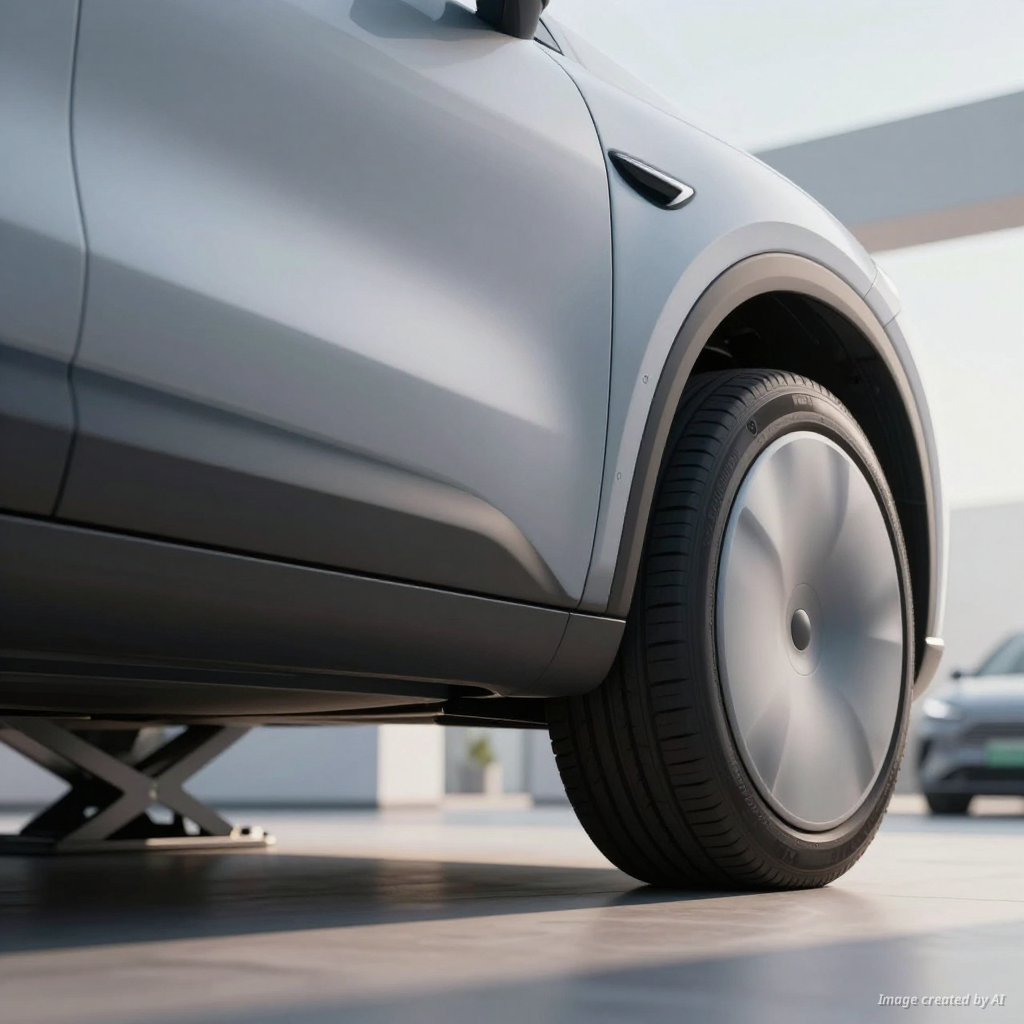
- Aerodynamic wheel covers that prevent air from swirling inside the wheel wells.
These features often work in tandem with electric motor control software for performance optimization to ensure the vehicle remains as efficient as possible in various driving conditions.
The trade-offs of sleek design
While aerodynamic efficiency is vital, it does come with certain design compromises. The teardrop or fastback shapes that excel in wind tunnels can sometimes limit rear headroom for passengers. Additionally, the quest for a low $C_d$ can occasionally impact rear visibility or trunk space.
Despite these challenges, the benefits are too great to ignore. For many buyers, the increased range provided by a slippery, aerodynamic design is more valuable than traditional styling cues. As battery costs remain a factor, the industry will likely continue to prioritize these “invisible” efficiency gains [5].
The future of vehicle efficiency
Looking ahead, we can expect even more radical designs. Concept vehicles like the Mercedes-Benz Vision EQXX have already pushed the boundaries with a $C_d$ of 0.17. These prototypes serve as testbeds for technologies that will eventually reach mass-market vehicles.
As we move toward a future of sustainable transportation, the role of aerodynamics will only grow. It is no longer just about aesthetics or speed; it is about maximizing every watt of energy stored in the battery. By focusing on the science of airflow, automakers are proving that the most effective way to go further is to simply get out of the wind’s way.
More Information
- Coefficient of drag ($C_d$): A dimensionless number that quantifies the resistance of an object in a fluid environment like air. A lower value indicates a more aerodynamic shape that experiences less air resistance.
- Frontal area ($A$): The total area of the vehicle’s front profile that faces the oncoming wind. Reducing this area is critical for minimizing the total drag force exerted on the vehicle at high speeds.
- Active aerodynamics: Systems on a vehicle that automatically change shape or configuration—such as spoilers or grille shutters—to optimize airflow based on current speed and cooling needs.
- Turbulent wake: The area of disturbed, low-pressure air that forms behind a moving vehicle. Minimizing this wake is essential for reducing the “pull” or drag that slows the vehicle down.
- Fastback silhouette: A car design where the roofline slopes continuously down to the rear bumper. This shape is highly favored in EV design for its ability to keep airflow attached, reducing drag.